Hope and the Visual Arts
 
Picture
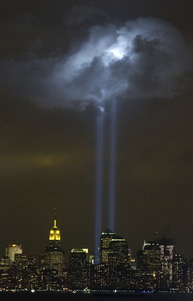
I just finished a novel that would be a candidate for good discussions among Christian artists  – The Submission by Amy Waldman. In this story the protagonist is Mohammed Khan, an American-born and -educated architect, son of Muslim immigrants from India, who wins an anonymous contest to design a 9/11 memorial. When his identity is revealed, the design jury, the public, American Muslims and the artist himself face conflicts of interest involving grief, entitlement, fairness, faith, and what art can or should do in the context of a public tragedy.

Integrity is one theme of the story. How does a non-practicing Muslim face the sudden hostility his very name evokes? Does he owe loyalty to his roots, his ancestry, when his whole life has been a secular American success? In what ways and to what degree is he responsible to himself, his art, his people? Who are his people?

Should the jury stand behind ther choice in the face of virulent opposition? Who gets to decide whether to build the winning design  – the loudest, most strident voices or some kind of majority vote, the politicians or the art experts? Should the artist withdraw his design for the sake of a peaceful end?
 
 
Picture
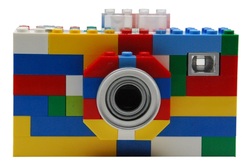
I have subscribed for several years to a newsletter called The Painter’s Keys, which explores topics relating to painting. This recent post about photographing artwork, and the responses to it, is a real keeper.
In the article is information about photo copyright, best type of camera to use, and tips for taking a good photo, as well as comments from people who prefer to hire a professional photographer. (Check out my suggestions here.)


Picture
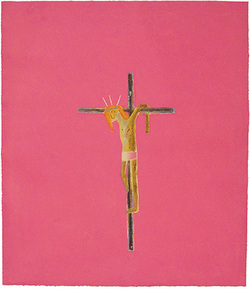
Pink Crucifixion by Craigie Aitchison
I have unfortunately missed an exhibit of works from the Methodist Church Art Collection, which closed on June 11. Not that I could have attended, since it was in Edinburgh, Scotland. But hearing about it informed me of a collection I knew nothing about and another group of Christians working through the theology of art.

About the collection:
"It focuses on episodes in the life of Christ and invites the viewer to look through the medium to the God who can reveal himself not only through the spoken word but also through material, created things.
It is an invitation to exercise our imaginations, to learn more about the richness of God's being, and to offer him glory and praise."

According to The Methodist Church in Britain, the collection began as the vision of two people in the 1960s who wanted Methodists to " become more aesthetically aware and understand art and faith." They raised the funds to buy and commission works of art separately from the Church general revenue.

The church also offers a DVD study series based on the artworks aimed at church and home group leaders. It is intended to aid Bible study and prayer. I intend to order it and will let you know what I think. (Since it is produced in Great Britain, the discs will only be playable in the US on multicode DVD players.)
 
 
I sometimes wonder if nonartists have any notion of what an artist is doing and thinking when they work. The process behind the creation of a moving piece of art must seem quite mysterious. Even to other artists it is not always apparent (which is one reason I like artist statements). Audrey Lopata, an artist who attends Hope Chapel, wrote the following about her first Christian arts conference. I love how she illuminates one aspect of the deliberation behind making art, and how being at the conference helped her figure out something important to her growth as an artist.

Picture
"Attending the CIVA conference was, like conferences tend to be, an experience much like drinking from a fire hose. The wild intelligence and brilliant words were flying so fast and furious that my notes are more a cryptic jungle of odd quotations than a coherent summary of my experience. Phrases like, “I’m looking for something that I’m not sure exists,” and “today is going to be about yellow,” gallivant across the pages of my notebook, teasing me with allusions to deeper meaning. Don’t get me wrong, I loved the conference. I left feeling mentally exhilarated, if not a bit exhausted.

"When it was all said and done, and I was trying to make sense of it all while puttering around LAX waiting for my flight, and I wasn’t  sure what to think. But, as I continued to process and journal, this is what floated to the surface, the pure gold nugget of “take-away” knowledge: the idea of voice.

"The question, “what is it that you’re trying to say with your work?” was posed to me during a critique of one of my portfolio pieces. A bit flustered I answered “I just sort of felt like drawing fashion that day.” The profound lameness of my own answer really got me to thinking. And as I continued to attend the different talks and seminars I begin to see much more clearly the “voice” of the presenters in their work. Their passionate vision to communicate some truth or to pose a question that needed to be asked. I was challenged and thrilled to be in the presence of so many good thinkers. Art is the language we all speak, so what exactly am I trying to say? I’m still not sure I have the answer, but working toward finding my voice is a step in the right direction, and I’m glad CIVA inspired me to take it."


Even though Audrey's passion is illustrating children's books, she is not just interested in making pretty pictures. She wants to find something true and bring it to life visually. This is how artists come to create art that is not idolatrous. They "illustrate" the larger story of hope against the background of all the small stories of despair or resignation. The art becomes an avenue of escape into a larger reality instead of narrowing into mere consolation.
 
 
Picture
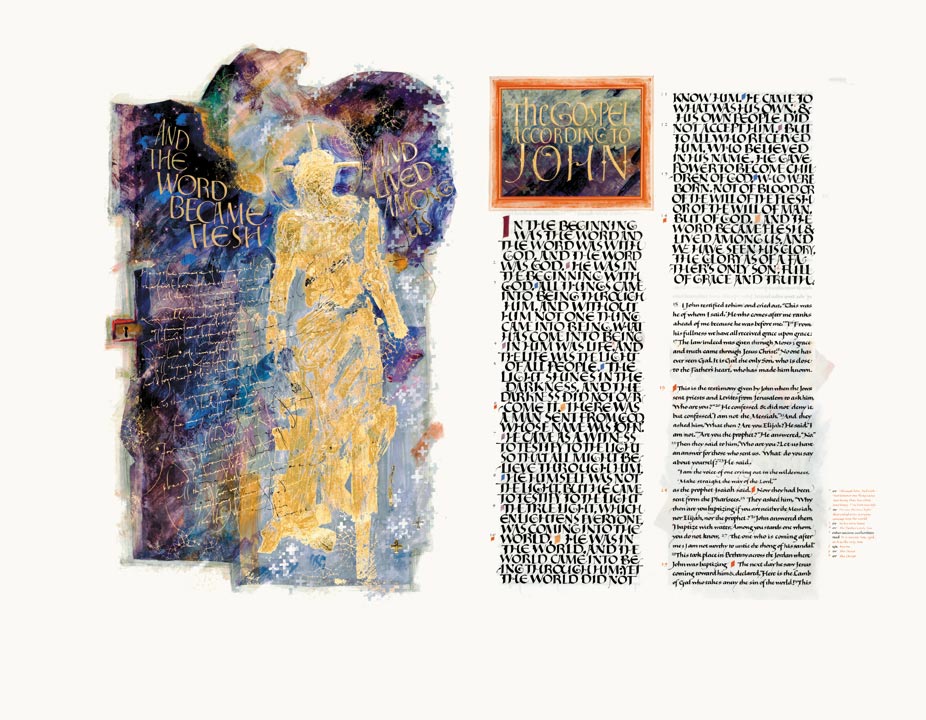
Christ Our Light, detail, from The Saint John's Bible
 Another project you should check out along with The Four Holy Gospels is The Saint John's Bible. This handmade Bible, commissioned by Saint John's Benedictine Monastery in Minnesota, follows the medieval manuscript tradition even more closely. Calligrapher Donald Jackson is the artistic director. He designed the calligraphic hand for the text, and he and several other calligraphers have been using that style to write out the whole Bible on calfskin vellum for some ten years. Jackson and many other artists have produced the page decoration and full-page artworks throughout the book.

For centuries throughout the Christian world, manuscripts similar to The Saint John's Bible and The Four Holy Gospels were rare and precious possessions of a local church community. They were often very large books, visible to many at one time. They were read during mass, displayed publicly on holy days and used with prayer to bless the community and petition God for healing. Many years and the skills of many artists went into their making.

Picture
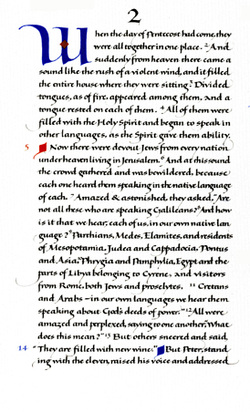
Acts 2:1-14 from The Saint John's Bible
Relatively inexpensive printing now allows almost any person, certainly any community, to own a high-quality reproduction of all or part of The Saint John's Bible manuscript. No calfskin pages or real gold leaf, but still splendid. The Four Holy Gospels is also affordable, also splendid in its design and binding and repro-ductions of the original art. So what should we do with these two illuminated books? What is their place in the life of believers?

Are they coffeetable books? Sure, display them for your callers. Their beauty will draw people in.
Are they private devotionals? Both Fujimura and Saint John's Monastery want people to use them in this way. The books (almost the same size, interestingly) are larger than your Bible but not too large to handle, and the texts are accepted modern translations.
What else? Could they be the center of a small group study? Could pages be projected during worship or a sermon instead of a Powerpoint image? Could they be used to focus corporate prayer? Could they be inspiration for art that grows out of your community?
How might your church community respond to these books that 
                                                                  join our beloved ancient words with images forged in the souls of
                                                                  modern artists?


Picture
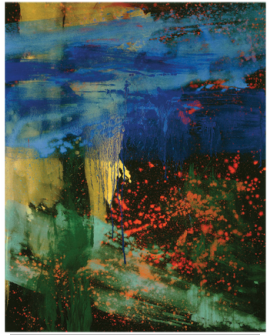
The Tears of Christ from The Four Holy Gospels
 MOBIA (the Museum of Biblical Art) is one of my favorite destinations when I visit New York City. This summer they will host an exhibit commemorating the 400th anniversary of the King James Bible, featuring both historical works and abstract paintings by Makoto Fujimura made for his new book, The Four Holy Gospels.

The book, commissioned by Crossway publishers, references the centuries-long traditions of handmade illuminated liturgical books – full-page illustrations before each section, smaller illustrations throughout, and decorated letters to begin chapters. But Fujimura's, of course, are completely modern.


Picture
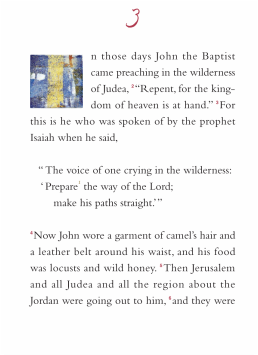
Matthew 3:1-5 from The Four Holy Gospels

Although I have  seen only a few images from the book as yet, to me the project is exciting in many ways. Artistically, because Fujimura is one of the most accomplished abstract artists alive, and his powerful work moves even many who are unfamiliar and uncomfortable with modern art. Theologically, because of the potential for a new type of image to aid contemplation of the gospel texts. Practically, because it is a commission. A committed group of believers thinks it is important enough to pay an artist to do this work.

"The true purpose of art is the same as the true purpose of anything; it is not for ourselves or for our own self-expression, but for the service of others and the glory of God."
Philip Graham Ryken

 
What is art for? 06/06/2011
 
When I was in my twenties and jobs were hard to come by and I was trying not to be a waitress anymore, I applied for a job writing copy for a parts catalog. I had degrees in German, English and dance, and I was both desperate and confident. The man who interviewed me was clearly intrigued by me, but puzzled. He asked me why I thought I could do the job. I thought for a minute and said that everything I had done until then was about communicating -- through other languages, through writing, through doing and teaching art. And that I could communicate about parts, too. I didn't get the job, but it was a revelatory moment. For me, a major reason I make art is to communicate of myself, to connect out from the isolation of me.

I recently looked at Philip Yancey's website, where he ruminates about the question of why we make art. He distinguishes between art as a goad to prod us to action (a prophetic act) and art as a nail that becomes embedded in society to remind us of the questions that eternally trouble us (a rare and unpredictable work).
Then he proposes a third metaphor of art -- as a way of marking time, of writing in sand, an activity he sees as more trivial than higher forms of service to God, like the work his wife does as a hospital chaplain. Yet he also lauds the necessity and value of just such trivial acts of rebellion against the prevailing world of "greed and lust, manipulation and exploitation, fearful and painful sensations" (Henri Nouwen's reaction to seeing the 1980 movie "Stuntman").

I have always felt my art to be just that trivial. It has affected almost no one, changed nothing, passed on little. I have longed to be a nail, but mostly I write in the sand. The great thing about being part of a Christian community is being able to add together our many trivial acts and become part of something a little larger, maybe a little more nail- or goad-like.